
It happens to most people at some point. The light shifts in the late afternoon, hits the kitchen from an unexpected angle, and suddenly the cabinets you considered reasonably clean reveal themselves for what they actually are. Not dull. Not worn. Coated — in a thin, invisible film of cooking grease, fingerprints, and years of quick wipes that moved the grime around without ever truly lifting it.
The sticky drawer handle you had learned to pull with just two fingers. The patch above the stove with a faint, permanent shine that was never part of the original finish. The smudge around every knob that no amount of casual wiping seemed to shift. Once you notice these things properly, you cannot stop noticing them.
The instinct is to reach for whatever cleaning spray lives under the sink. Most people do exactly that. The bubbles appear, the lemon scent rises, the surface looks briefly promising — and then the cloth comes away with a thin smear of redistributed grime, and the cabinet looks marginally different but fundamentally the same. Still dull. Still faintly sticky. Still not clean.
Why Specialist Cleaners Often Disappoint
The cleaning product industry has spent decades persuading people that specific problems require specific products. Kitchen grease calls for a degreaser. Bathroom soap scum calls for a different formula. Every surface, every stain, every room has its own brightly labeled solution. The cumulative cost of stocking all of them is considerable. The cumulative effectiveness, in many kitchens, is less impressive than the packaging suggests.
The core problem with many multi-purpose kitchen sprays is that they are formulated to do several things at once — clean, fragrance, shine, and protect — and in trying to do all of these simultaneously, they often do none of them completely. They add a light layer of their own residue to the surface while partially shifting the existing grime. Over repeated use, these layers compound. The cabinet ends up wearing a blend of old cooking film and product buildup that becomes progressively harder to shift.
This is not a failure of effort. It is a failure of chemistry. And the solution to a chemistry problem is a different kind of chemistry — not a stronger spray, but a more targeted one.
The Forgotten Bottle at the Back of the Pantry
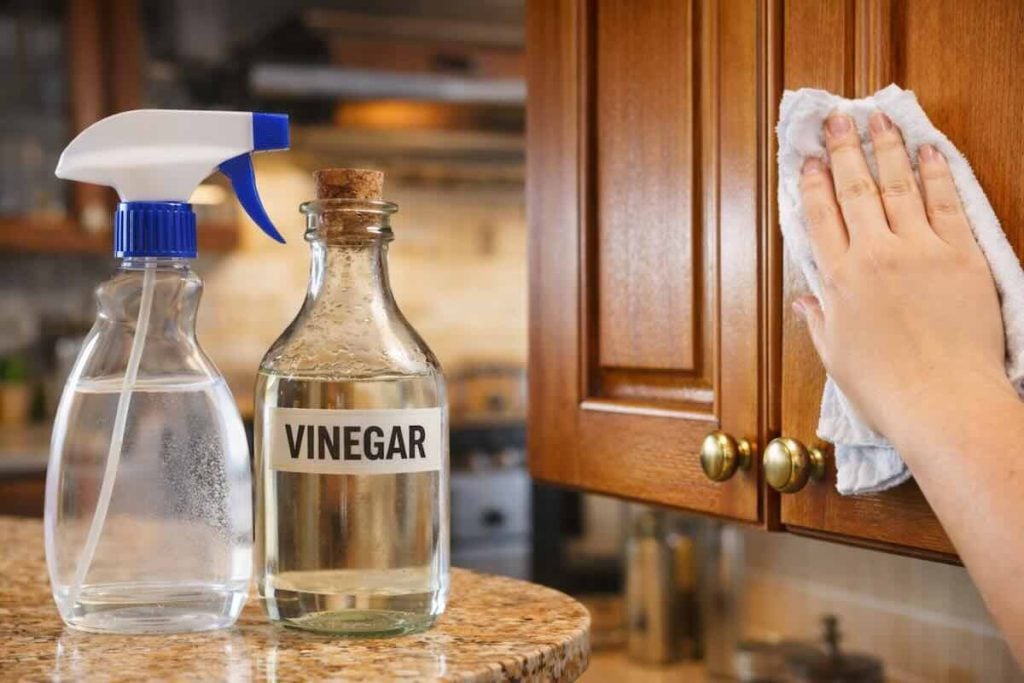
White distilled vinegar sits in most kitchen pantries in a state of perpetual neglect. It gets retrieved for salad dressings, pressed into service during occasional coffee machine descaling, and otherwise ignored. It carries no marketing promises. Its label does not feature action words or claim laboratory testing. It costs almost nothing and lasts almost indefinitely.
It is also, for the specific problem of kitchen cabinet grease, one of the most effective cleaning agents available.
The chemistry is straightforward. Cooking on a stovetop releases microscopic grease particles into the air. These particles travel, settle, and bond to nearby surfaces — cabinet fronts, drawer edges, handles, the tops of doors nobody ever touches. Over time, this invisible mist builds into a film that ordinary water cannot break down, because grease and water do not mix. What cuts through that film is acid — mild, gentle acid that loosens the bond between the grease molecules and the surface without damaging the finish underneath.
White vinegar is mildly acidic. Not corrosive, not harsh, but precisely tart enough to dissolve the grease bond that sends most cleaning sprays sliding off the surface without engaging. Mixed with warm water in roughly equal parts, it becomes a patient, penetrating solution that works with the chemistry of kitchen grime rather than against it.
A Simple Method That Actually Works
The approach requires almost no equipment and no particular technique. Mix equal parts warm water and white distilled vinegar in a bowl. For surfaces with heavier buildup, add two or three drops of mild dish soap to help lift residue that the vinegar alone might struggle with. Dip a soft cloth into the mixture, wring it out thoroughly so it is damp rather than dripping, and press it to the cabinet surface with gentle, steady pressure.
The difference from a standard cleaning spray becomes apparent almost immediately. Rather than skimming across the surface, the cloth meets a slight resistance as it engages the grease film, then begins to glide as that film dissolves. The drag smooths out. The cloth picks up a faint brownish tint that is both satisfying and faintly alarming — evidence of what had been sitting on the surface unnoticed.
Working in small sections, rinsing and re-dipping the cloth regularly, and following each pass with a dry cloth on real wood or plywood cabinets produces results that most dedicated kitchen degreasers cannot match. The finish that emerges is not artificial or shiny in a waxy sense. It is the original surface, finally visible again — the grain of the wood or the true color of the paint, freed from the haze that had settled over it.
Surfaces That Welcome This Treatment and Those That Do Not
White vinegar works well on sealed wood cabinets, painted surfaces in good condition, and most laminates. These are the materials that make up the vast majority of kitchen cabinetry, and for all of them, a diluted vinegar solution presents no risk to the finish when used correctly.
Several surface types need a different approach. Raw or unfinished wood should never meet vinegar — the acid penetrates unsealed grain and can cause damage that is difficult to reverse. Natural stone surfaces including marble and granite are similarly vulnerable, as acid etches and dulls polished stone over time. Very high-gloss or freshly painted cabinet surfaces warrant a test on a hidden area before full application, and a lighter vinegar ratio if any uncertainty exists.
Testing before committing is always worthwhile. A small, concealed section of cabinet interior, wiped with the diluted solution and left to dry completely, will reveal any adverse reaction before it affects a visible surface.
Building It Into the Kitchen Routine
The most effective approach to cabinet maintenance is not a single deep-clean session followed by months of neglect. It is a series of short, regular passes that prevent the grease film from accumulating to the point where it becomes a project.
Ten minutes while the kettle boils. A quiet half hour on a Sunday afternoon while something simmers on the stove. A few swipes across the cabinet fronts nearest the cooking zone at the end of a busy cooking week. These small, consistent interventions keep the surface in a state where the vinegar solution moves through grime rather than having to excavate it.
Starting with the cabinets closest to the stove makes practical sense — this is where grease particles settle most heavily and where the film builds fastest. Moving outward from there, working zone by zone over days or weeks rather than attempting the entire kitchen in one session, turns an overwhelming task into something manageable and even satisfying.
Remarkable Results in Overlooked Places
The areas that respond most dramatically to this treatment are often the ones people stop noticing because they have accepted them as permanently marked. The drawer front that developed a sticky patch years ago and has been pulled with reluctant fingertips ever since. The cabinet above the stove that carries a faint shine of old oil that no amount of wiping seemed to address. The handles and knobs that accumulate a grayish buildup in the recesses that standard sprays never fully penetrate.
On these surfaces, holding the damp cloth in contact for a few extra seconds before wiping — giving the mild acid time to engage the grease — produces results that feel genuinely surprising. The patch that seemed permanent lifts. The handle loses its tackiness. The recess around the knob comes clean. What the surface feels like afterward is not just clean but different in character — smooth and neutral rather than faintly resistant under the fingertips.
The Smell, the Drying, and What Remains
The sharp, distinctive scent of vinegar is the most common concern people raise before trying this approach. It is a reasonable concern. Undiluted vinegar has a strong smell that many people find unpleasant in an enclosed kitchen space.
Diluted in warm water, the scent softens considerably. More importantly, vinegar is volatile — it evaporates quickly and completely as it dries. Within minutes of the final wipe, the smell fades. What remains is essentially no scent at all. Not a synthetic fragrance designed to signal cleanliness, but the genuine neutral smell of a surface that carries nothing extra on it. That absence of smell is, in itself, a reliable sign that the cleaning has worked.
What Changes When the Cabinets Are Genuinely Clean
There is a shift in how a kitchen feels when its surfaces are truly clean rather than merely tidy. Light moves differently in the room. Colors read more accurately. The small, repeated interactions with cabinet doors and drawer handles — reaching for a glass, grabbing a pan, pulling open the spice cupboard — lose the faint, almost unconscious resistance that sticky surfaces create.
This is not a dramatic transformation. It is a quiet one. But it accumulates into something that changes the daily experience of being in the kitchen in ways that are difficult to articulate until they have been felt.
The other change is practical and financial. A bottle of white distilled vinegar costs a fraction of any specialist kitchen cleaner and performs better on grease film than most of them. Using it consistently removes the need for the rotating collection of part-used sprays that most kitchens accumulate — each promising something specific, each delivering something partial.
The Honest Case for Simple Solutions
There is a broader truth that the vinegar method illustrates. The most effective solution to a domestic problem is not always the most elaborately marketed one. Sometimes the chemistry that works best is the chemistry that has always worked — the mild acid that cuts grease, the warm water that carries it away, the soft cloth that lifts it from the surface.
The next time the afternoon light hits the kitchen at an honest angle and reveals what has been settling on the cabinets, the response does not need to involve a trip to the cleaning products aisle. It needs warm water, a splash from the bottle at the back of the pantry, and ten minutes of unhurried attention.
The result is a kitchen that feels genuinely clean — smooth under the hand, clear in the light, and free from the invisible film that most cleaning products simply rearrange.