
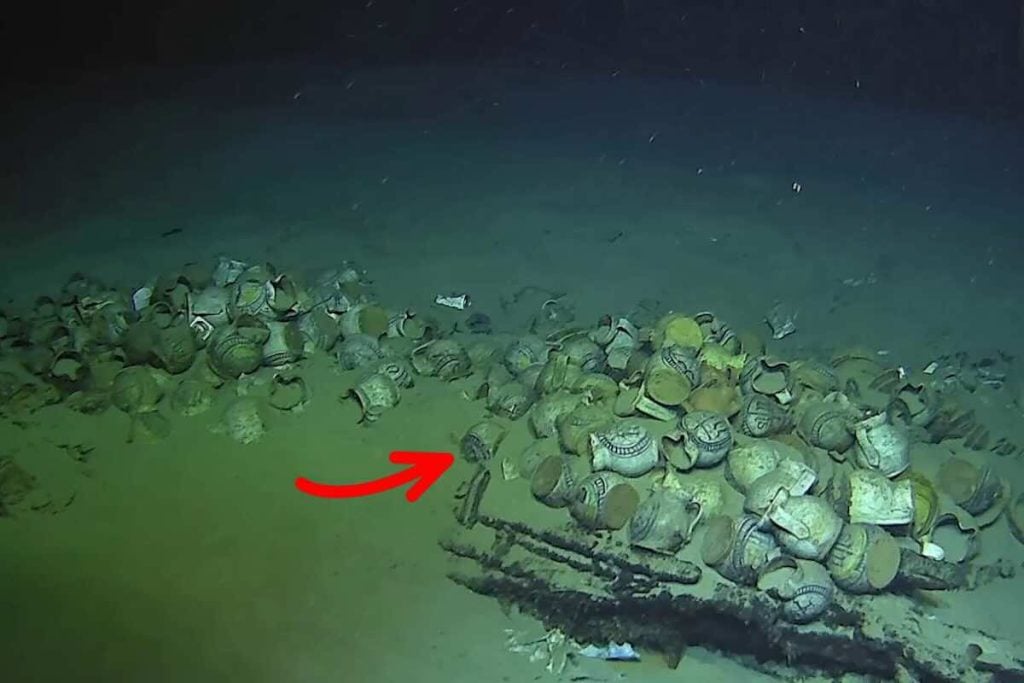
It began with an anomaly on a sonar screen. During a French naval maritime mission in the Mediterranean, instruments detected an unusual echo from more than 8,200 feet below the surface — a depth where light has never reached and water pressure crushes most materials into unrecognisable forms. Underwater drones descended into the darkness and returned with images that stopped the research team in place.
Sitting undisturbed on the seabed, perfectly preserved after more than five centuries, was a 16th-century Italian merchant vessel. What surrounded it told two entirely different stories about human civilisation — one from the Renaissance, and one from the present day.
A Time Capsule on the Seabed
The ship measures approximately 100 feet in length. Its cargo holds contain around 200 amphorae, the large ceramic vessels used throughout the Mediterranean world to transport wine, oil, grain, and other goods across sea routes that connected the ports of Italy, France, Spain, and North Africa. Alongside the amphorae, researchers identified glazed ceramic plates, two large cauldrons, and six cannons — all of them intact, their forms clear and legible after five centuries of cold, still darkness.
Several of the amphorae carry religious markings that provide a clue to the vessel’s origin. The inscription “IHS” — a symbol derived from the Greek rendering of the name of Jesus, widely used in Catholic devotional imagery during the Renaissance period — points strongly toward the Ligurian coast of northern Italy. The ship almost certainly departed from a port in that region, loaded with goods bound for markets elsewhere in the Mediterranean world, and never arrived.
Marine archaeologist Sadania described the site as a time capsule where history appears frozen. The description is apt in a precise, literal sense. The combination of factors at this depth — cold temperatures that slow biological decay, near-total darkness that prevents photosynthesis and the organisms that depend on it, sediment conditions that gradually enveloped and stabilised the hull, and an almost complete absence of human disturbance — created a preservation environment that museums and conservators can only approximate. The ship did not so much sink into history as settle into a kind of suspended state, waiting.
What the Wreck Reveals About Renaissance Trade
Merchant shipping in the 16th-century Mediterranean operated within a dense network of commercial relationships that bound the Italian city-states, the Ottoman Empire, the Iberian kingdoms, and the emerging Atlantic powers into a web of mutual economic dependency. Liguria, and the port of Genoa in particular, sat near the centre of this network. Genoese merchants and sailors moved goods, credit, and information across the sea with a sophistication that anticipated modern global trade in ways that are easy to underestimate.
The cargo aboard this vessel reflects that world directly. Amphorae of the type found here served the same function that standardised shipping containers serve today — modular, stackable, universally understood units of measure and transport. The cannons indicate that the ship operated in an era when merchant vessels needed to defend themselves, or at minimum to project the appearance of being capable of doing so. The glazed ceramic plates suggest cargo intended for sale to buyers with some purchasing power — not bulk commodity trade, but differentiated goods moving through a market.
Finding a vessel of this type in such complete condition offers researchers a physical record of Renaissance maritime commerce that documents and paintings can only partially convey. The shape of the hull, the arrangement of the cargo, the construction techniques used in the cannons — all of these carry information about 16th-century shipbuilding, navigation, and trade practice that no written source fully preserves.
The Objects That Should Not Be There
When the high-resolution imaging from the underwater drones came back for detailed analysis, the initial excitement encountered something that complicated the picture entirely. Among the amphorae and ceramic plates, the cameras had captured at least two metallic objects that bore no resemblance to anything from the 16th century. Their shape was unambiguous. They appeared to be soda cans — products manufactured sometime in the latter half of the 20th century, now resting beside cargo loaded onto a ship before the concept of industrial manufacturing existed.
The question of how contemporary consumer waste reached a site more than 8,000 feet below the surface of the Mediterranean requires an understanding of ocean current dynamics that is still not fully mapped. The Mediterranean is not a static body of water. Its surface currents, shaped by wind patterns, temperature gradients, and the complex geography of its coastline, connect distant points in ways that are not always intuitive. Deeper thermohaline circulation — driven by differences in water temperature and salinity — moves water masses slowly but over enormous distances and through the full depth range of the ocean.
Scientists believe that objects entering the Mediterranean at the surface — discarded from vessels, blown from coastal areas, or carried by rivers from inland sources — can travel through these current systems over weeks, months, or years, gradually sinking as they absorb water or become weighted by accumulated sediment, until they come to rest on the seabed at depths far from where they entered the water column. A can discarded in a harbour in Marseille or tossed from a ferry crossing the Ligurian Sea might, over years of drifting and sinking, arrive at a location that seems impossibly remote from any human activity.
A Collision of Centuries
The image that the discovery presents — modern consumer waste lying beside Renaissance amphorae at the bottom of the sea — compresses the distance between historical periods in a way that is difficult to process emotionally or intellectually. The merchant who loaded those amphorae onto the ship in a Ligurian port sometime in the 1500s lived in a world where the Mediterranean represented the known commercial universe, where the goods in those ceramic vessels represented real wealth, and where the idea of material waste accumulating in the ocean at industrial scale would have been entirely inconceivable.
The gap between that world and the one that produced the soda cans beside those amphorae is vast in technological and social terms. In terms of the ocean’s capacity to preserve and connect them, the gap disappears entirely. The seabed does not distinguish between a 16th-century cargo vessel and a 20th-century piece of packaging. Both settle, both remain, both become part of the record that the deep ocean keeps of human activity at the surface.
This is what makes the discovery more than an archaeological curiosity. It is a demonstration, in physical and visible form, of what marine pollution research has been arguing in statistical and abstract terms for years. There is no part of the ocean that human waste cannot reach. The depth and remoteness that preserved this shipwreck for 500 years did not prevent modern debris from finding it.
Remarkable Technologies Shaping the Next Phase
French authorities have committed to returning to the site over the coming two years with an expanded research programme. The next phase will deploy the latest generation of deep-water submersible technology to conduct detailed physical exploration of the wreck — examining the hull structure, the arrangement and condition of the cargo, and the precise nature of the modern objects found among it.
Alongside the physical exploration, researchers will produce comprehensive three-dimensional digital reconstructions of the entire site. These models serve a dual purpose. They allow detailed study of the vessel’s construction and cargo arrangement without the physical contact that risks damaging fragile five-century-old materials. They also create a permanent digital record of the site as it currently exists — a baseline against which future observations can be compared to assess any change or deterioration.
The 3D reconstruction work may also help answer a question that the initial discovery left open. Whether the modern objects found at the site represent incidental contamination carried by ocean currents, or whether they arrived through some other mechanism, remains unclear. Detailed spatial mapping of exactly where these objects sit in relation to the wreck’s structure may provide clues about how and when they arrived.
What the Ocean Is Keeping
The Mediterranean seabed holds an archaeological record of extraordinary density. The sea connected civilisations for thousands of years before the Atlantic routes opened, and the vessels that moved across it — Phoenician, Greek, Roman, Byzantine, Arab, Genoese, Venetian, Ottoman — left behind wrecks that carry direct physical evidence of the trade, technology, and culture of their periods. Most of these wrecks remain undiscovered. Many that have been located have not been fully documented. The conditions that preserved this 16th-century Italian merchant vessel exist at comparable depths across the entire basin.
The same conditions that make this archaeological record so valuable also make it vulnerable in a specific and modern way. The currents that distribute marine pollution across the Mediterranean do not spare deep water sites. Every wreck that sits on the seabed within range of these current systems is potentially accumulating the same kind of modern debris found beside the Italian merchant vessel. The archaeological context — the spatial relationships between objects that allow researchers to reconstruct what happened to a ship and what it was carrying — degrades when foreign material enters the site and cannot be distinguished from cargo.
Protecting the underwater archaeological record and addressing marine pollution are not separate challenges. The discovery near Saint-Tropez made that connection visible in a way that technical reports about ocean contamination rarely manage. A soda can beside a Renaissance amphora is harder to argue with than a parts-per-million measurement of microplastics in deep water samples.
A Record That Outlasts Its Makers
The merchant who sailed from Liguria in the 1500s left behind a physical record of that voyage that has now survived longer than any document or building from the same period would be likely to survive. The ocean preserved it without intention, through the simple operation of cold and pressure and darkness and sediment.
The objects that joined that record from the surface of the 20th-century Mediterranean will remain there for timescales that dwarf the interval since the ship sank. Metal corrodes slowly in cold deep water. Certain plastics persist for centuries under any conditions. Whatever the ocean receives from the surface, it tends to keep.
That persistence is what gives the image of modern debris beside a Renaissance shipwreck its particular weight. Both are now part of the same permanent record. Future researchers examining this site — in fifty years, or five hundred — will find them together, and will draw from that combination conclusions about the civilisation that produced both.